See the science.
Change the variables.
Discover what equations actually do. Explore beautiful, hands-on mathematics and physics with reliable models, live measurements and lessons written to help you understand.
Change forces, angles, rays and waves.
See real-time results and equations.
Use examples, lessons and experiments.
Choose an experiment. See it unfold.
Explore teaching experiments spanning optics, mechanics, waves, electricity and orbital motion.
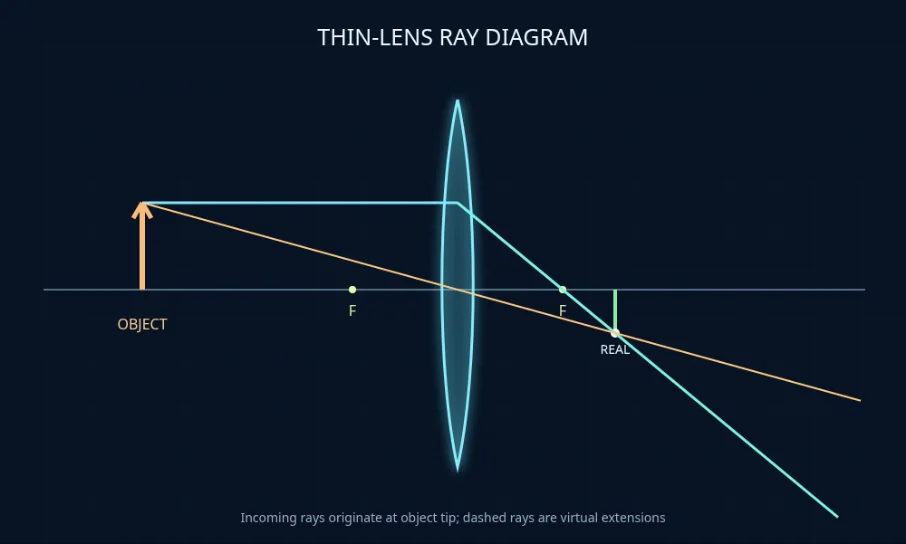 Optics1/f = 1/dₒ + 1/dᵢ
Thin Lens Simulator
Move an object toward or away from converging and diverging lenses. Watch light rays travel and discover when images are real, inverted, virtual or enlarged.
Open interactive lesson →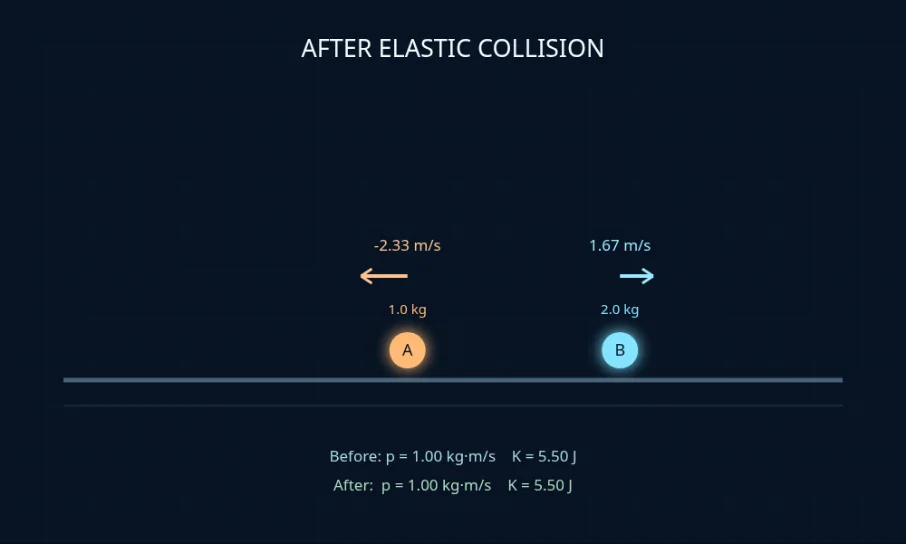 Mechanicsp = m₁v₁ + m₂v₂
Elastic Collision Simulator
Send two masses toward each other and watch what happens at their impact. Compare velocities before and after an ideal elastic collision, with momentum and kinetic energy preserved.
Open interactive lesson →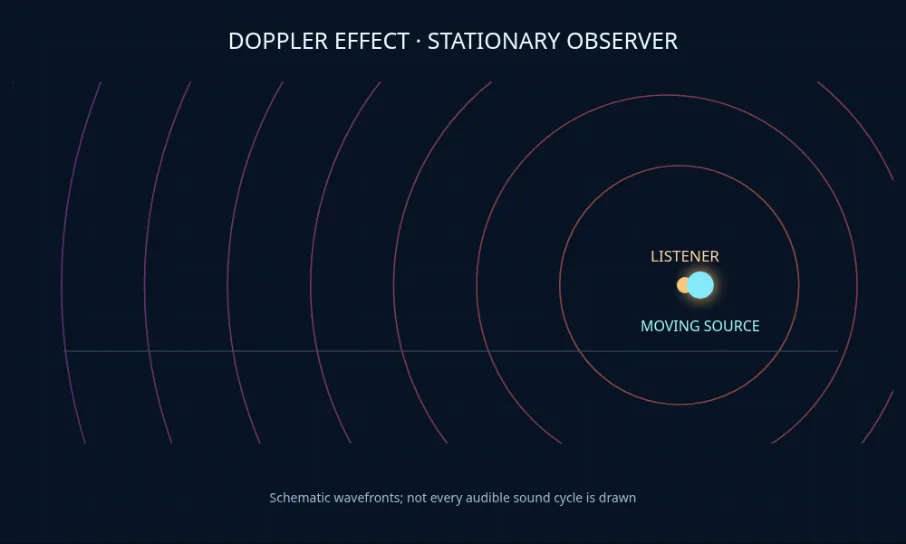 Waves & Soundfₒ = fₛ c / (c ∓ vₛ)
Doppler Effect Simulator
Watch expanding wavefronts bunch up in front of a moving source and spread out behind it. Predict the change in perceived frequency before and after it passes a stationary listener.
Open interactive lesson →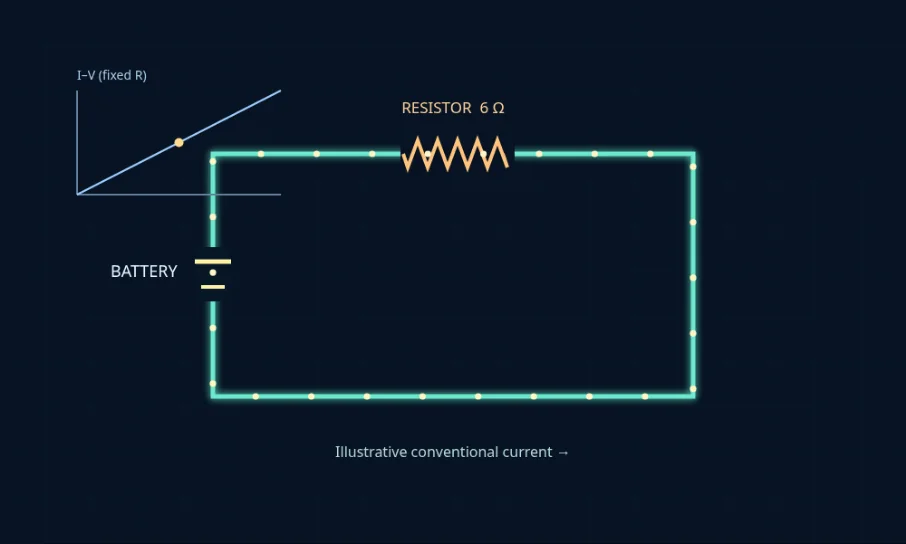 Electricity & CircuitsV = IR
Ohm’s Law Simulator
Change the battery voltage and resistor value to observe how steady current and resistor power change. View an animated closed circuit and the I–V relation.
Open interactive lesson →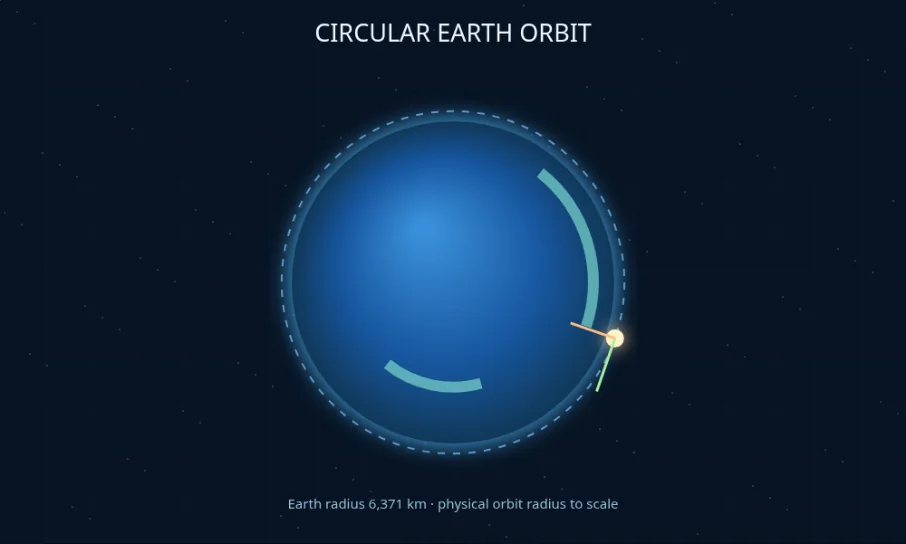 Astronomy & Spacev = √(GM / r)
Circular Orbit Simulator
Adjust a satellite’s altitude and watch its circular orbit. Measure speed, period and gravitational acceleration while visualizing the inward force and tangential velocity.
Open interactive lesson →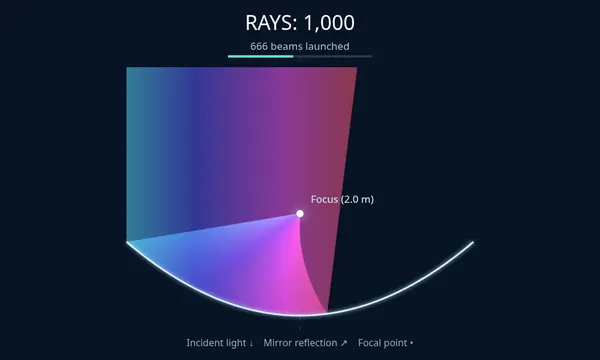 Opticsy = x² / (4f)
Parabolic Mirror Simulator
Trace parallel rays striking a parabolic mirror. Watch the reflected paths converge to a single focus as you change focal length and ray density.
Open interactive lesson →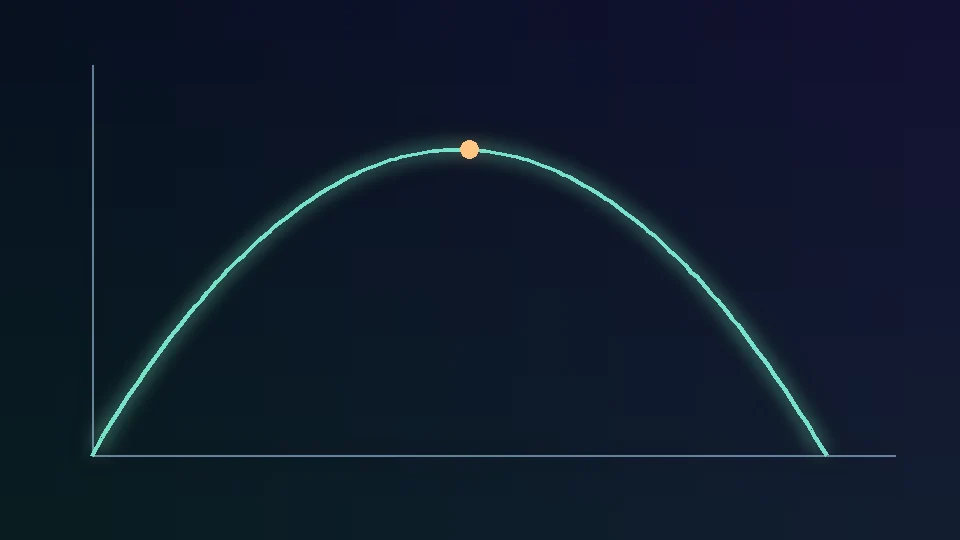 Mechanicsx = v₀ cos(θ) · t
Projectile Motion Simulator
Launch a ball without air resistance. Adjust angle, speed and gravity to see the trajectory and calculate range, flight time and maximum height.
Open interactive lesson →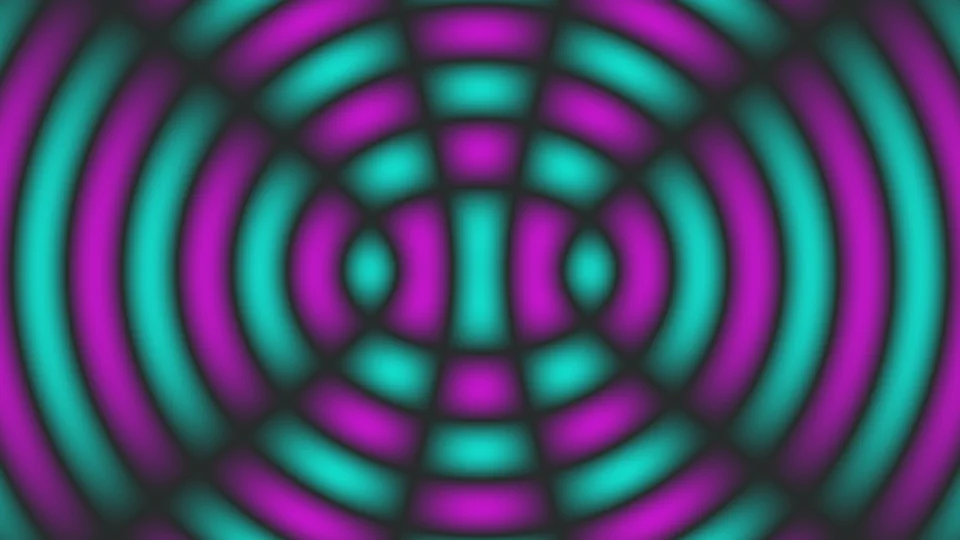 Waves & Soundu = A cos(kr₁ − ωt) + A cos(kr₂ − ωt)
Wave Interference Simulator
See two coherent wave sources send ripples across the same surface. Change wavelength and source spacing to reveal zones of reinforcement and cancellation.
Open interactive lesson →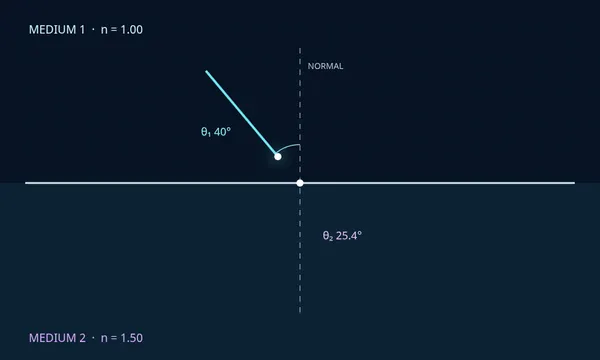 Opticsn₁ sin θ₁ = n₂ sin θ₂
Refraction & Snell’s Law Simulator
Follow a moving ray as it reaches the interface between two materials. Calculate the refracted angle or watch total internal reflection.
Open interactive lesson →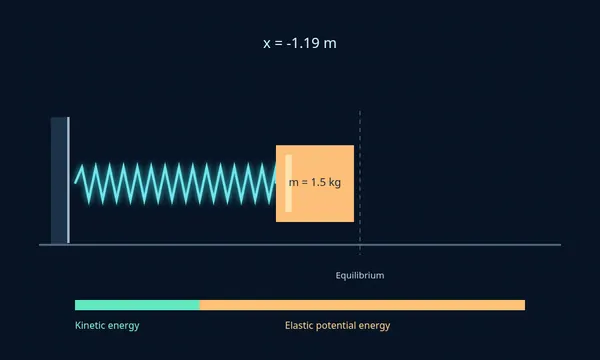 Mechanicsω = √(k/m), T = 2π√(m/k)
Spring–Mass Oscillator Simulator
A spring and mass oscillate smoothly while live measurements show displacement, period, angular frequency and the balance between kinetic and elastic potential energy.
Open interactive lesson →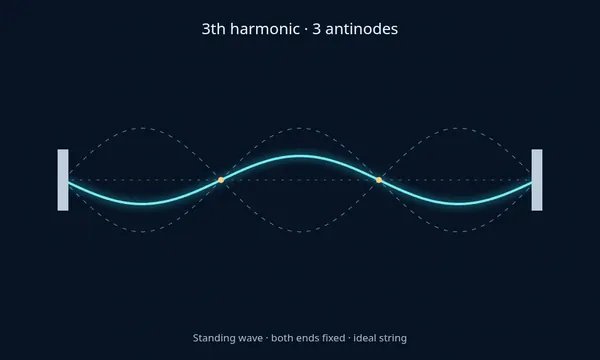 Wavesfₙ = n√(T/μ) / (2L)
Standing Waves on a String
Watch an ideal vibrating string form distinct harmonics, nodes and antinodes. Explore how tension and linear mass density affect resonant frequency.
Open interactive lesson →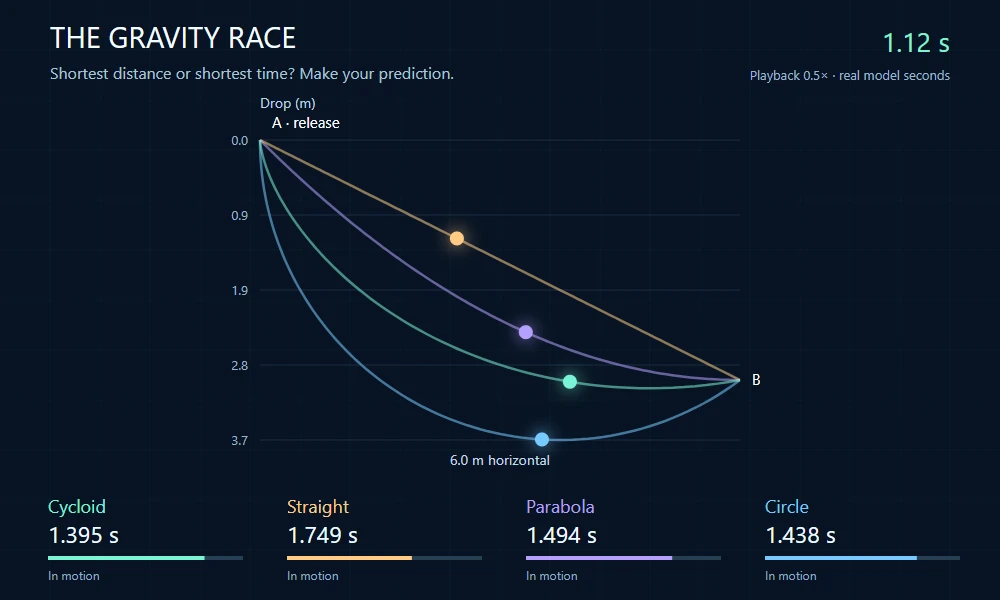 Mechanicsx = a(θ − sin θ), y = a(1 − cos θ); v = √(2gy); T = θ₁√(a/g)
Brachistochrone Gravity Race
Four beads leave the same point at rest and reach the same lower destination. Predict which track wins, then compare a straight line, a parabola, a circular arc and the fastest cycloid. A longer route can arrive sooner by gaining speed earlier.
Open interactive lesson →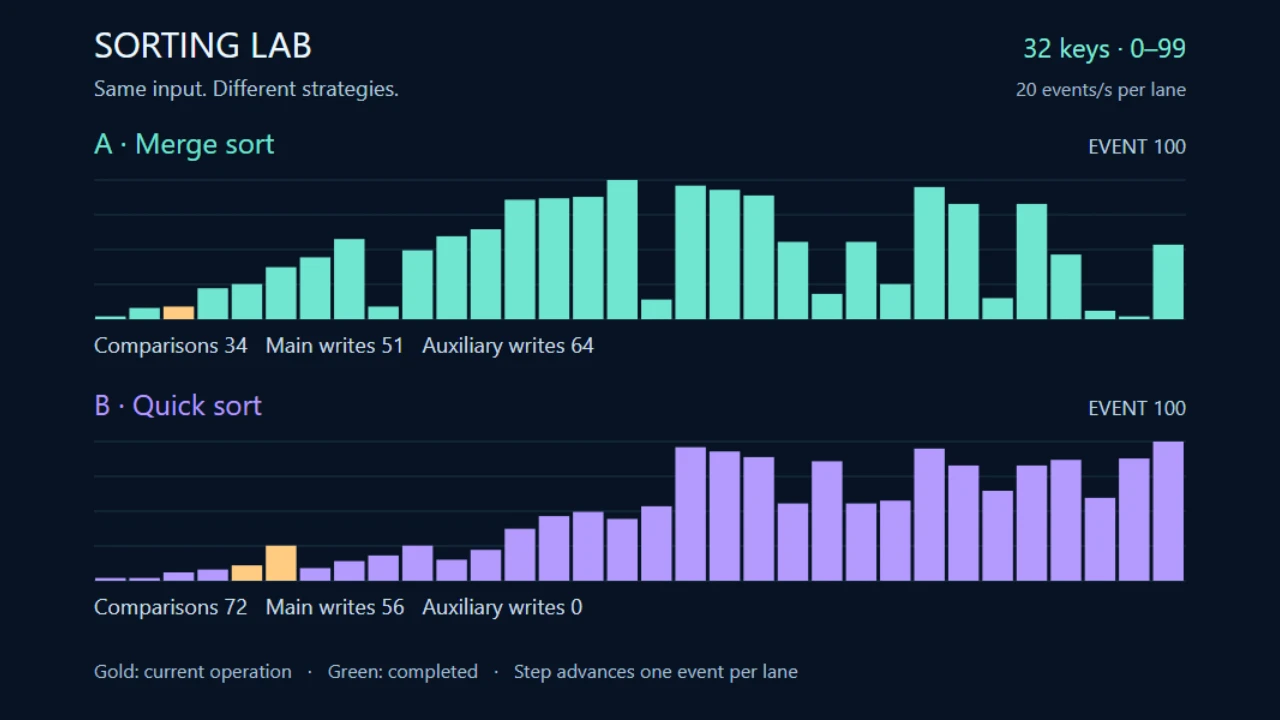 Computer ScienceComparison lower bound: worst case Ω(n log n) for arbitrary distinct keys
Comparison-Based Sorting Visualizer
Can Bubble sort finish before Quick sort? On already sorted input, an early-exit Bubble sort needs one pass while a poor Quick-sort pivot can cause quadratic work. Compare seven actual implementations on identical data and discover why the input and the implementation matter.
Open interactive lesson →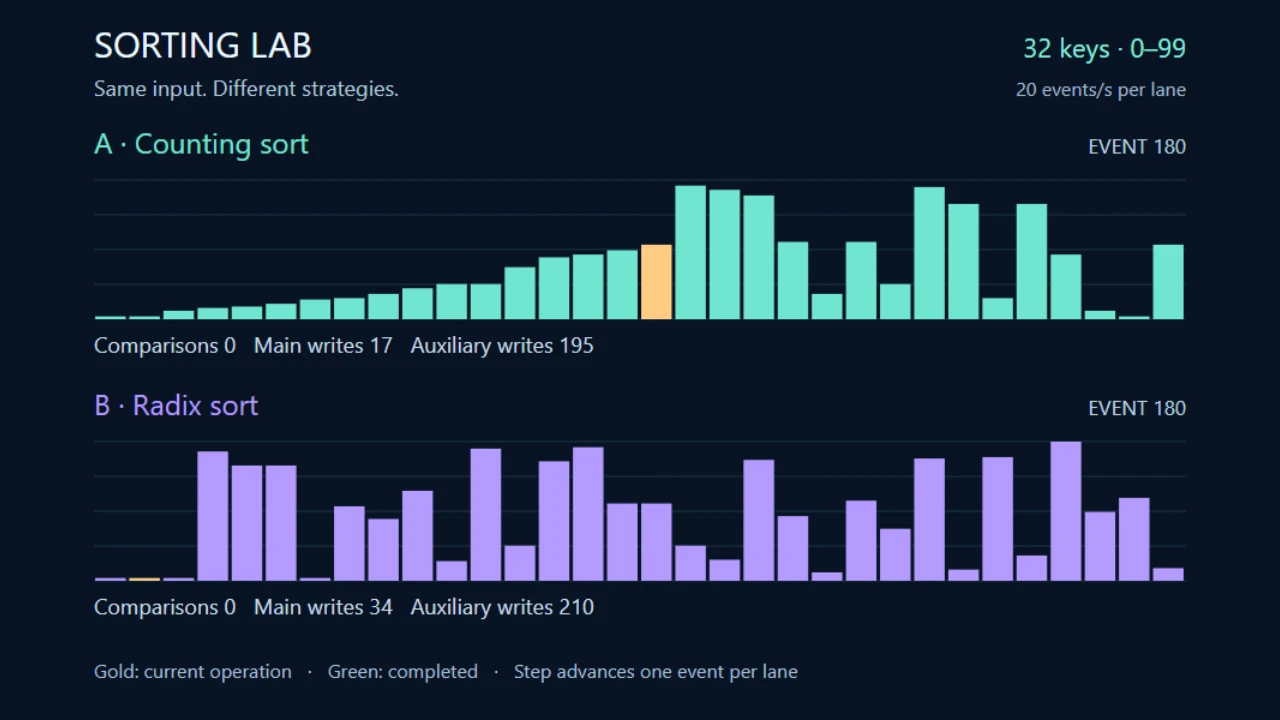 Computer ScienceCounting: Θ(n + k) · LSD radix: Θ(d(n + b))
Non-Comparison Sorting Visualizer
How can numbers be sorted without comparing every pair? Use the values themselves as addresses, read one digit at a time or distribute records into ranges. Explore Counting, Radix and a hybrid Bucket sort to see what extra knowledge about the keys makes possible.
Open interactive lesson →Don't just watch.
Experiment.
Change a parameter. Make a prediction. Compare what you expected with the outcome. Use the equations and live readouts to connect what you see to what you learn.
How we build scientific visualizations →Models, not moving wallpaper
Flagship experiments use documented mathematical models, with explicit assumptions and limitations.
Readable on any screen
Large experimental stages, simple first controls and fullscreen classroom viewing.
Learn as you explore
Every flagship experiment includes learning outcomes, real examples, exercises and references.
More patterns to explore.
18 additional creative simulation prototypes organized by subject. These are visual learning demonstrations, not yet peer-reviewed classroom models.