What will you understand?
- Separate horizontal uniform motion from vertical accelerated motion.
- Connect launch angle and speed to range, maximum height and flight time.
- Compare ideal trajectories under Earth-like and Moon-like gravity.
How the simulation works
Two motions, one trajectory
A projectile moves horizontally at constant velocity when air drag is neglected, while its vertical velocity changes by g every second. Horizontal and vertical motions are independent but happen simultaneously.
The highest point
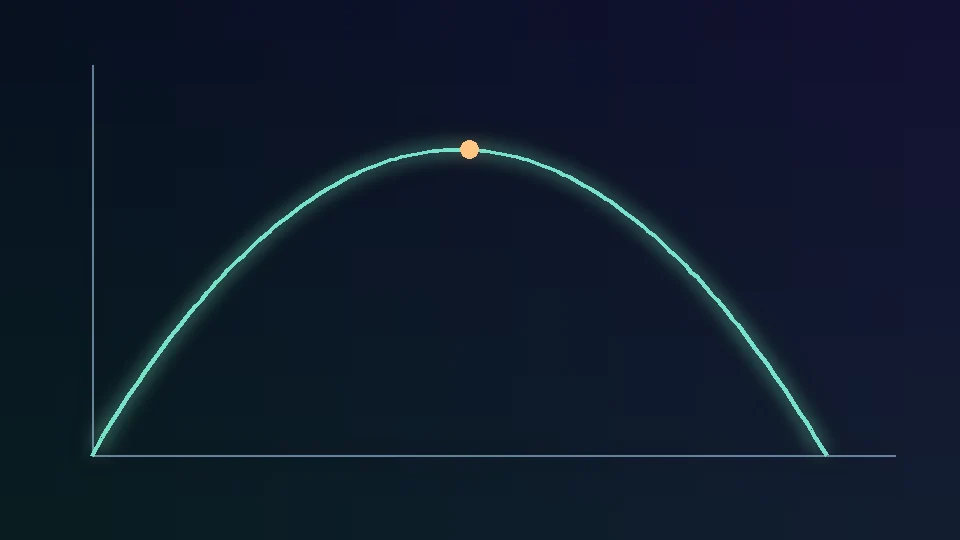
At maximum height the vertical velocity is momentarily zero, though horizontal velocity remains non-zero. The maximum height above launch level is (v₀ sinθ)²/(2g).
What makes 45° special?
For launch and landing at the same height, fixed initial speed, uniform gravity and no air drag, the greatest horizontal range occurs at 45°. A real football or baseball may behave differently because drag, wind and launch height matter.
Use the controls above to change the relevant parameters. All displayed values follow the assumptions stated on this page.
Three experiments to try
- Set 20 m/s, 45°, and Earth gravity. Predict the range before running.
- Change the angle from 30° to 60° at the same speed; compare their range.
- Select Moon gravity and see how the ideal flight time and range change.
Calculate it before you visualize it
For v₀ = 20 m/s, θ = 45°, g = 9.81 m/s², and equal launch/landing heights: T = 2v₀sinθ/g ≈ 2.88 s; R = v₀²sin(2θ)/g ≈ 40.77 m; H = v₀²sin²θ/(2g) ≈ 10.19 m.
Can you predict the result?
On level ground, with equal speed and no air resistance, which travels farther: a 30° launch or a 60° launch?
Reveal the answer
They have equal horizontal range. sin(60°) and sin(120°) are equal in the ideal range equation.
What the model does not show
This is an ideal point-mass model with uniform downward gravitational acceleration and level landing at launch height. No air resistance, spin, lift, collisions, wind, or changing gravitational field are included.
Science sources
This teaching implementation follows idealized textbook models. It is designed for exploration and should not be used for engineering design or safety decisions.
OpenStax College Physics 2e — Projectile Motion ↗
Model implementation: MG Labs teaching model. Independent subject-matter review and classroom testing are still pending.