What will you understand?
- Explain how gravity supplies centripetal acceleration.
- Calculate circular-orbit speed from gravitational parameter and radius.
- Predict how orbital period changes with altitude.
How the simulation works
Why the satellite keeps falling
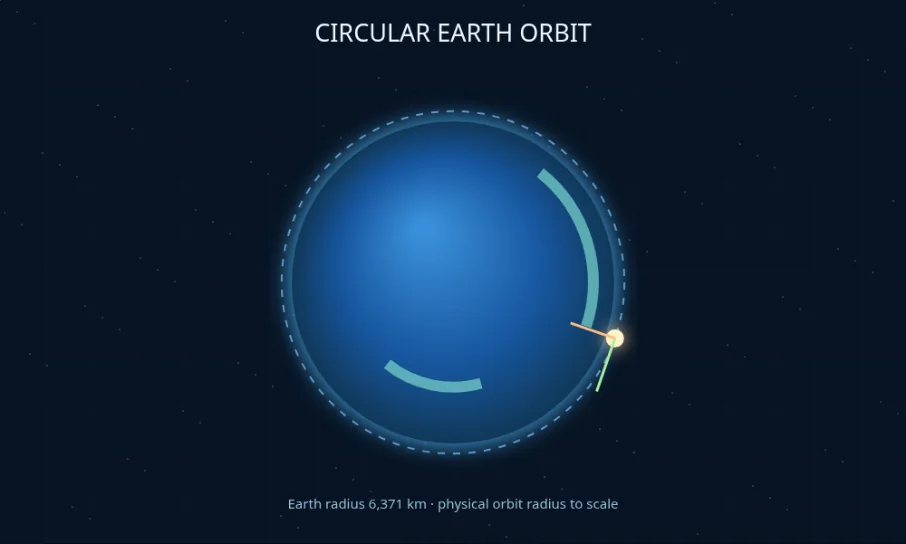
Earth’s gravity bends a satellite’s otherwise straight path into a circular orbit. The inward gravitational acceleration equals v²/r for ideal circular motion.
Why higher can mean slower
Circular orbital speed is v = √(GM/r). A satellite higher above Earth requires a slower circular speed and takes longer to make one orbit.
What the animation scales
Earth and orbit sizes use a single consistent scale for radius, but time is accelerated for teaching. The spacecraft symbol is enlarged for visibility.
Use the controls above to change the relevant parameters. All displayed values follow the assumptions stated on this page.
Three experiments to try
- Compare the speed and period at 400 km versus 1,200 km altitude.
- Increase altitude and predict the change in gravitational acceleration.
- Use the speed and period numbers to test the circumference/period relation.
Calculate it before you visualize it
Take Earth’s gravitational parameter μ = 3.986004418×10¹⁴ m³/s² and radius R = 6371 km. At 400 km altitude, r = 6.771×10⁶ m, v ≈ 7.67 km/s, and the circular period is about 92.4 minutes.
Can you predict the result?
Does an ideal circular satellite at a higher altitude need to orbit faster or slower?
Reveal the answer
Slower. Its orbital speed decreases as 1/√r while its period increases as r^(3/2).
What the model does not show
Ideal Earth-centered two-body circular orbit; fixed gravitational parameter, spherical Earth, no atmosphere, oblateness, perturbations or maneuvering. Time is accelerated and the satellite icon is not to scale.
Where you will encounter this physics
Circular-orbit calculations provide a first approximation to many Earth satellites. Real trajectory prediction requires perturbations, atmospheric drag and orbit corrections, particularly for low Earth orbit.
Common misconceptions
- Assuming higher satellites must travel faster to stay in orbit. In a circular orbit they travel slower.
- Forgetting altitude is not the same as radius: Earth radius must be added.
- Using the accelerated animation time as if it were real orbital time. The simulator reports physical period separately.
Try it with a class
Compare two circular altitudes. Let learners predict whether speed, gravitational acceleration and period increase or decrease; then verify using the displayed data.
Science sources
This teaching implementation follows idealized textbook models. It is designed for exploration and should not be used for engineering design or safety decisions.
OpenStax University Physics Vol. 1 — Satellite Orbits and Energy ↗
Model implementation: MG Labs teaching model. Independent subject-matter review and classroom testing are still pending.