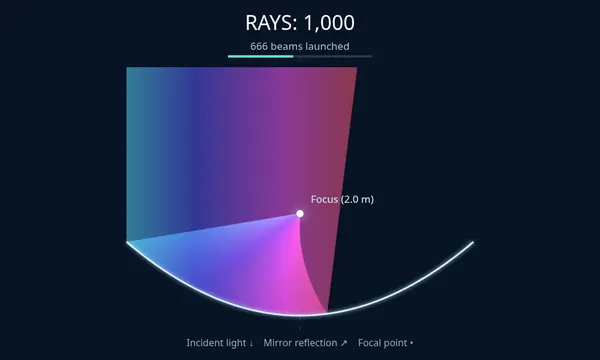
What will you understand?
- Explain how a mirror’s surface normal determines the reflected direction.
- Identify the vertex, symmetry axis, and focal point of a parabola.
- Predict how the reflected rays change when focal length changes.
How the simulation works
The shape of a parabola
In coordinates with the vertex at the origin and the axis pointing upward, a parabolic cross-section obeys y = x²/(4f). The parameter f is the distance between the vertex and the focus. A larger focal length makes the curve shallower over the same width.
Why the rays converge
At each contact point the reflected direction is calculated by reflecting the incoming direction about the local surface normal. When the incoming rays are parallel to the symmetry axis, ideal geometric reflections intersect at (0, f). The focus remains at the same physical location even when more rays are added.
Rays are not rainbows
Different colors in this laboratory help separate paths. They do not mean the parabolic mirror splits white light into its component wavelengths. A perfect mirror does not act like a prism.
Use the controls above to change the relevant parameters. All displayed values follow the assumptions stated on this page.
Three experiments to try
- Start with 10 rays and identify the point where they meet.
- Switch on the progressive reveal and compare 10, 100 and 1,000 rays; determine whether the focus changes.
- Increase the focal length; observe how the mirror becomes shallower and the focus moves away from the vertex.
Calculate it before you visualize it
If f = 2 m and a point lies 2 m from the axis, then the height of the parabola is y = 2²/(4 × 2) = 0.5 m above the vertex. Parallel incident rays passing through that point reflect toward the point (0, 2 m).
Can you predict the result?
If we increase the ray count from 10 to 1,000 without changing the shape, does the focus move?
Reveal the answer
No. More rays reveal the same geometric focusing property; their count does not change the mirror geometry.
What the model does not show
This is two-dimensional ideal ray optics. Rays are parallel to the symmetry axis, reflection is specular, and diffraction, surface defects, absorption and finite thickness are omitted. Colors are illustrative.
Science sources
This teaching implementation follows idealized textbook models. It is designed for exploration and should not be used for engineering design or safety decisions.
OpenStax University Physics Vol. 3 — Spherical Mirrors and Parabolic Reflectors ↗
Model implementation: MG Labs teaching model. Independent subject-matter review and classroom testing are still pending.