What will you understand?
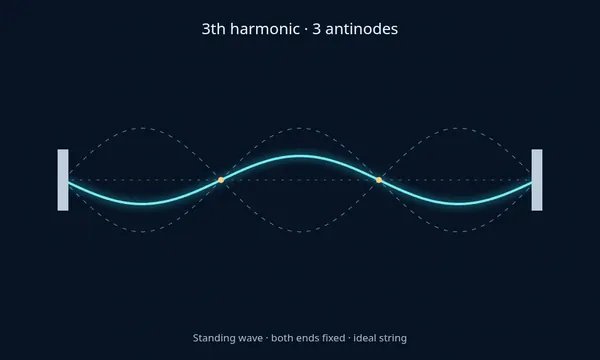
- Identify nodes and antinodes in standing waves.
- Predict the number of loops and nodes of each harmonic.
- Calculate the harmonic frequency from wave speed, length and mode number.
How the simulation works
Two equal waves traveling opposite ways
A standing wave results when two coherent traveling waves of equal amplitude move in opposite directions. Their superposition forms fixed positions of zero displacement called nodes.
Fixed boundary conditions
Both ends of the ideal string are nodes. For a string of length L, the n-th allowed wavelength is 2L/n and its frequency is n v/(2L).
Wave speed and tension
A uniform string under tension T and linear mass density μ has ideal wave speed v = √(T/μ). More tension raises wave speed; a heavier string lowers it.
Use the controls above to change the relevant parameters. All displayed values follow the assumptions stated on this page.
Three experiments to try
- Change the harmonic from 1 to 4 and count how many loops appear.
- Increase tension at fixed density and notice the wave oscillates faster.
- Increase linear mass density and observe the decrease in frequency.
Calculate it before you visualize it
For a 3 m string under 48 N tension with μ = 0.12 kg/m, wave speed is √(48/0.12) = 20 m/s. Its fundamental frequency is 20/(2×3) ≈ 3.33 Hz, and the third harmonic is 10 Hz.
Can you predict the result?
How many internal nodes are there for the third harmonic on a string fixed at both ends?
Reveal the answer
There are two internal nodes, plus the two fixed end nodes, for four nodes in total.
What the model does not show
Ideal small-transverse-displacement normal modes of a uniform taut string fixed at both ends. There is no damping, stiffness, external forcing, nonlinear tension changes or coupling to surrounding air. Motion is analytically prescribed.
Science sources
This teaching implementation follows idealized textbook models. It is designed for exploration and should not be used for engineering design or safety decisions.
OpenStax University Physics Vol. 1 — Standing Waves and Resonance ↗
Model implementation: MG Labs teaching model. Independent subject-matter review and classroom testing are still pending.