What will you understand?
- Use gravitational potential energy to calculate bead speed at a given drop.
- Distinguish minimum distance from minimum travel time.
- Compare curves fairly using identical endpoints, gravity and release conditions.
- Explain why changing gravity changes every arrival time by the same factor.
How the simulation works
A fair race between paths
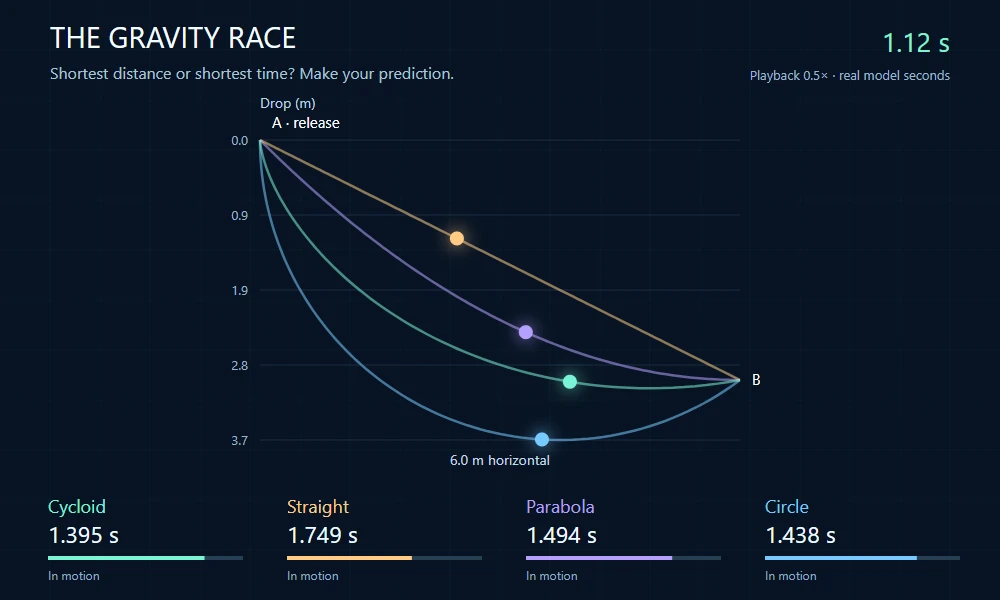
The start A is at x = 0, y = 0 and the finish B is at horizontal distance X and downward drop Y. The four beads start simultaneously from rest. Each is constrained to slide along its track without friction or rolling. All tracks share those two endpoints. The line is shortest in distance, but travel time depends on speed along the entire route. The tracks have different slopes, so gravity accelerates the beads differently along them. The screen uses the same horizontal and vertical scale: a steep-looking slope represents a steep physical slope.
Energy determines speed, but not position at a given time
With y measured downward from the release point, conservation of mechanical energy gives one half m v squared = m g y. The mass cancels, leaving v = square root of 2 g y. Beads at the same vertical drop therefore have the same speed, even when they are on different tracks or reach that height at different times. A path that descends sharply lets its bead gain speed early. That bead can then spend more of the journey moving quickly. At the common finish, all four ideal beads have the same speed; the winner did not need a larger final kinetic energy.
Why the cycloid is special
The brachistochrone is the curve of least descent time under these ideal conditions. It is a cycloid segment with x = a(theta minus sine theta) and y = a(1 minus cosine theta). This simulator solves for the positive scale a and endpoint angle theta so the cycloid reaches the selected X and Y. The first non-looping segment is used. On that segment the travel time is T = theta times square root of a/g. When the destination is relatively far away and shallow, the fastest track can descend below B and climb back up. That extra drop can buy enough early speed to outweigh the longer distance.
How the other curves are compared
For the straight line, x = X u and y = Y u. The parabola uses x = X u and y = Y u(2 minus u). The circular arc starts vertically, with x = R(1 minus cosine phi), y = R sine phi and R = (X squared plus Y squared)/(2X). Here u runs from zero to one and phi ends at 2 arctangent(X/Y). These are specific comparators, not claims that every parabola or circle with arbitrary constraints behaves identically. Their times come from integrating distance divided by speed along each curve.
A finite time despite starting at zero speed
The expression dt = ds divided by square root of 2gy appears singular at the release point because y and speed are zero. The total time is still finite for these tracks. The numerical calculation substitutes u = q squared, removing the integrable starting singularity before Simpson integration. The cycloid time also has an independent analytical expression. The straight-line answer supplies another benchmark. The animation uses physical elapsed seconds and a cached time-position table, rather than moving each bead at a decorative constant speed.
Use the controls above to change the relevant parameters. All displayed values follow the assumptions stated on this page.
Three experiments to try
- Use the Classic race preset. Predict the ordering, then use Start and Pause to compare where the beads are at the same elapsed time. Read the four arrival times in Settings.
- Try Wide, shallow drop. Look for tracks that pass below the destination before rising. Explain why the upward final section does not necessarily make the journey slower.
- Compare Earth and Moon gravity at identical endpoints. Divide an Earth arrival time into the corresponding Moon arrival time and compare with square root of 9.81/1.62.
Calculate it before you visualize it
For X = 6 m, Y = 3 m and g = 9.81 m/s², the endpoint equation gives theta approximately 3.508369 radians and a approximately 1.551600 m. The cycloid time is 3.508369 × sqrt(1.551600/9.81) = 1.395277 s. The straight-line result is sqrt(2(X² + Y²)/(gY)) = 1.748744 s. Numerical integration gives about 1.493816 s for this parabola and 1.438145 s for this circular arc. Every bead reaches B with speed sqrt(2 × 9.81 × 3) = 7.672 m/s. The displayed playback speed of 0.5× makes the animation take twice as long on screen, but does not change these physical arrival times.
Can you predict the result?
The straight line reaches B last in the default race. Does its bead also have the lowest speed at B?
Reveal the answer
No. All beads lose the same gravitational potential energy between A and B. Without friction or rolling, all have the same final speed sqrt(2gY). Their arrival times differ because their speeds differ during the journey.
What the model does not show
Ideal point beads on rigid constraining tracks, released from rest in uniform gravity. No rolling inertia, friction, drag, finite bead size or track deformation. A bead remains constrained even on the rising section. The endpoint search uses the first cycloid arch with 0 < theta < 2π. Comparator times use numerical quadrature and animation positions interpolate a time table; they are educational calculations, not engineering certification. Displayed beads stop at B to make arrival order readable; the stop is not a modeled collision. This is a brachistochrone race, not a tautochrone demonstration.
Where you will encounter this physics
This problem illustrates an optimization principle useful well beyond tracks: minimizing one quantity does not necessarily minimize another. A route planner may distinguish shortest distance from shortest travel time. Here the speed is determined by gravitational energy, so the analogy is conceptual rather than a road-traffic model. The cycloid is also connected to the tautochrone problem, which asks about equal descent times from different starting points on one curve. That is a separate experiment with different release conditions.
Common misconceptions
- The shortest path must be fastest: this would require suitable speed assumptions, and speed is not constant here.
- The winning bead has more energy: all beads have the same energy change between the common endpoints.
- A heavier point bead wins: mass cancels in this ideal sliding model.
- The animation's playback speed changes gravity: playback only changes how model time is shown.
- The track with the steepest start is automatically optimal: travel time depends on the whole curve, not only its first slope.
Try it with a class
Ask groups to predict the ranking before starting. Assign a common X and Y, record all four arrival times, and calculate the relative time saved by the cycloid compared with the straight line. Have another group repeat the setup using a shared link. Next change only gravity and test inverse-square-root scaling. Advanced learners can integrate ds/sqrt(2gy) independently and compare convergence at different sampling densities. Discuss why a rolling marble on a real track is not the same as this frictionless sliding point bead.
Science sources
This teaching implementation follows idealized textbook models. It is designed for exploration and should not be used for engineering design or safety decisions.
Wolfram MathWorld — Brachistochrone Problem and its mathematical references ↗
Model implementation: MG Labs teaching model. Independent subject-matter review and classroom testing are still pending.