What will you understand?
- Measure incidence and refraction angles from the surface normal.
- Use Snell’s law to calculate refraction between materials.
- Find when total internal reflection occurs from a high-index medium.
How the simulation works
Why light changes direction
Light travels at different phase speeds in different transparent, homogeneous media. At a flat boundary, the tangential component of the wavevector is preserved, so the propagation direction generally changes.
Angle is measured from the normal
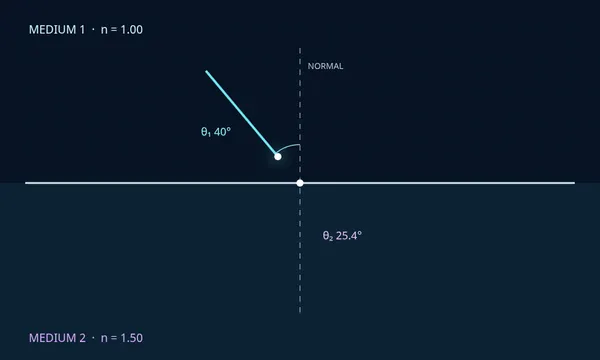
Both incidence θ₁ and refraction θ₂ are measured with respect to the perpendicular to the boundary, not the boundary itself. Higher refractive index usually means a ray bends toward the normal.
Total internal reflection
When light goes from a larger index n₁ to a smaller index n₂, and the incidence angle is above arcsin(n₂/n₁), no propagating refracted ray exists in the geometric-optics model. The ray reflects back into the first medium.
Use the controls above to change the relevant parameters. All displayed values follow the assumptions stated on this page.
Three experiments to try
- Start with air n₁ = 1.00 and glass n₂ = 1.50 at 40°. Predict whether the ray bends toward the normal.
- Make both indices equal; observe that the transmitted direction no longer bends.
- Try n₁ = 1.50, n₂ = 1.00 and raise the incidence angle above 42° to explore total internal reflection.
Calculate it before you visualize it
From air into a medium with n₂ = 1.50 at incidence θ₁ = 30°, Snell’s law gives sin θ₂ = (1.00/1.50)sin 30° = 1/3, so θ₂ ≈ 19.47°. At a glass-to-air boundary with n₁ = 1.50 and n₂ = 1.00, the critical angle is arcsin(1/1.5) ≈ 41.81°.
Can you predict the result?
What happens to a light ray entering a medium with a higher refractive index at the same nonzero incidence angle?
Reveal the answer
It bends toward the normal, making a smaller angle to the normal in the second medium.
What the model does not show
A two-dimensional, monochromatic geometric ray model of a sharp, planar boundary. The display omits polarization, Fresnel reflection amplitudes, absorption, scattering, dispersion and evanescent fields. Index values are user-defined illustrations.
Science sources
This teaching implementation follows idealized textbook models. It is designed for exploration and should not be used for engineering design or safety decisions.
OpenStax University Physics Vol. 3 — Refraction ↗
Model implementation: MG Labs teaching model. Independent subject-matter review and classroom testing are still pending.