What will you understand?
- Calculate total linear momentum and kinetic energy for two objects.
- Predict post-collision velocity based on masses and initial velocities.
- Distinguish elastic from inelastic collisions.
How the simulation works
Momentum stays the same
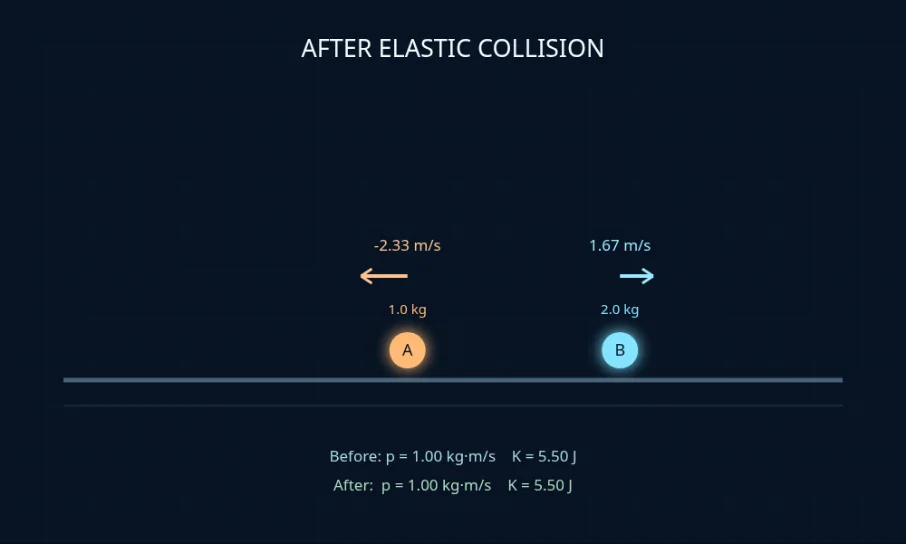
For two masses colliding on a line with no external impulse, m₁u₁ + m₂u₂ = m₁v₁ + m₂v₂. The momentum bar compares values before and after.
Elastic means energy is conserved too
In a perfectly elastic collision, total kinetic energy is the same before and after. Together, the two conservation laws give the final velocity of each object.
Why mass ratios matter
Equal masses exchange velocities; a light moving ball rebounding from a much heavier ball can reverse direction. The displayed collision is ideal and instantaneous.
Use the controls above to change the relevant parameters. All displayed values follow the assumptions stated on this page.
Three experiments to try
- Use equal masses and watch the two bodies exchange velocities.
- Double mass 2 while keeping speeds fixed. Compare the rebound of mass 1.
- Verify the before/after total momentum and kinetic energy stay the same.
Calculate it before you visualize it
For m₁ = m₂ = 1 kg, initial speeds u₁ = +3 m/s and u₂ = −1 m/s, the bodies exchange velocities: v₁ = −1 m/s and v₂ = +3 m/s. Momentum is +2 kg·m/s before and after; kinetic energy is 5 J both times.
Can you predict the result?
Two identical masses collide elastically head-on. What happens to their velocities?
Reveal the answer
For a one-dimensional elastic collision, equal masses exchange velocities.
What the model does not show
One-dimensional point-mass collision with effective disks for visibility, no walls, no friction and no energy loss. Impact is instantaneous at a fixed center separation; the shown disk sizes are schematic.
Where you will encounter this physics
Collisions are fundamental in particle accelerators, sports analysis and mechanical engineering. The ideal elastic case is a useful reference: real impacts can lose mechanical kinetic energy to sound, heat and deformation while still conserving total momentum in an isolated system.
Common misconceptions
- Confusing momentum with kinetic energy: momentum can be negative, whereas kinetic energy cannot.
- Using only momentum conservation to determine two unknown final speeds in a two-body elastic collision.
- Assuming real-world vehicle crashes conserve mechanical kinetic energy. Most do not.
Try it with a class
Set equal masses first, then unequal masses. Have learners compute final speeds before pressing Start and check conservation totals to roundoff precision.
Science sources
This teaching implementation follows idealized textbook models. It is designed for exploration and should not be used for engineering design or safety decisions.
OpenStax College Physics 2e — Elastic Collisions in One Dimension ↗
Model implementation: MG Labs teaching model. Independent subject-matter review and classroom testing are still pending.